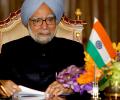
Hailed as the architect of India's economic reforms, former prime minister Manmohan Singh in one his last interviews had said in 2019 that the country's economy was 'over-regulated', the government exerted control and interferences were aplenty with even regulators having 'morphed into controllers'.

'As one of many immigrants at Nvidia, I know the opportunities we've found in America have profoundly shaped our lives.'
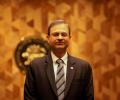
Reserve Bank of India (RBI)Governor Sanjay Malhotra on Friday said it was not the regulator's job to take decisions for bank boards, speaking in the context of the wide range of enabling reforms announced for lenders during the October monetary policy review, and emphasised that financial stability remained the regulator's focus.

Modelled loosely around the National Highway System of the US, he in 2001 launched the Golden Quadrilateral and the North-South & East-West Corridor projects to build 4/6 lane highways between four top metropolitan cities of Delhi, Mumbai, Chennai and Kolkata as well as from Srinagar to Kanyakumari and Porbandar to Silchar.

But their trajectory and direction have been largely influenced by politics and the political leadership's understanding of how the economy needs to be managed, explains A K Bhattacharya.

Chief Justice of India Bhushan Ramkrishna Gavai retired, reflecting on his career, commitment to the Constitution, and social justice.
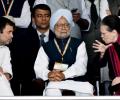
He drew the roadmap of India's economic reform, unshackled it from the licence raj and pulled it back from the brink when even its gold reserve was pledged.

Finance Minister Nirmala Sitharaman on Monday assured the industry that momentum of economic reforms will continue to make India a hotspot of global investment. India has turned the crisis created by COVID-19 pandemic into an opportunity to push the economic reforms, which remained pending for decades, she said while addressing the National MNC's Conference 2020 organised by industry chamber CII.

Finance Minister Nirmala Sitharaman on Thursday asked India Inc to take advantage of the policies and reforms undertaken by the government and no longer hesitate to invest more and expand capacities. Sitharaman also asked the industry to partner with the government for skilling the youth and also to engage with the government throughout the year, and not just before the Budget.
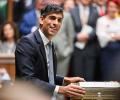
Former UK Prime Minister Rishi Sunak has taken on new academic roles at the University of Oxford and Stanford University, both alma maters of the Conservative Party member of Parliament. Sunak will join Oxford's Blavatnik School of Government as a member of the World Leaders Circle and a Distinguished Fellow, while at Stanford, he will be the William C Edwards Distinguished Visiting Fellow at the Hoover Institution. Sunak expressed his enthusiasm for contributing to both institutions, highlighting their leading research in global challenges, economic policy, and technological advancements. He emphasized the significance of his education at both universities in shaping his life and career. The appointments have been welcomed by both institutions, with leaders praising Sunak's expertise and experience in global affairs and economic policy.

Passenger vehicle retail sales shot up 35 per cent year-on-year during the nine-day Navratri period this year, helping the overall registrations last month grow 6 per cent, as offtakes remained muted in the first 21 days of the month and only took off after the roll-out of new GST rates on September 22, dealer' body FADA said on Tuesday.

President Droupadi Murmu addressed the nation on the eve of Independence Day, praising the response to terrorism, highlighting achievements in defense self-reliance, and emphasizing unity and progress.

Fitch Ratings on Wednesday raised India's GDP growth forecast to 6.9 per cent for current fiscal year, from 6.5 per cent earlier, citing strong June quarter growth and domestic consumption-led demand.

India had vehemently opposed Asian Development Bank's decision to grant $800 million loan to Pakistan saying the fund could be misused for increasing expenditure on its military, government sources said.

Recent developments - proposed changes to the goods and services tax (GST) rates and S&P Global Ratings' upgrade of India's long-term sovereign credit rating to BBB, with a stable outlook, - may not be enough to bring foreign investors back to Indian markets in a rush, feel analysts.

His five-year rule saw the Babri Masjid demolition, the rise of the saffron forces and also the country being placed firmly on a new economic path, away from the Nehru years of public sector socialism.

The crisis may not be as visible this time, but the stakes are just as high, points out Rajeswari Sengupta.

Across all sectors, the future of work depends on adaptability.

'Other sectors that manage the savings pools of Indians are giving tough competition to life insurance companies.'
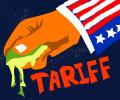
India needs to come together to deal with the 50 per cent punitive US tariffs on Indian products and stand up to any kind of bullying, Maruti Suzuki India chairman R C Bhargava said on Thursday. "It is our duty as Indians to do our very best to promote and maintain our dignity and respect and not give in to any kind of bullying in this matter... the nation has to stand united," Bhargava said at the company's 44th Annaul General Meeting in New Delhi.

'You are a guest in the US. It's not your home, you're a guest. If they don't feel comfortable, you have to step out.'

Simplifying GST rates, removing exemptions, easing disputes, and speeding up refunds can boost investment in India and offer the best reply to Trump's tariffs, observes V S Krishnan, former member, Central Board of Indirect Taxes and Customs.
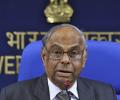
It is time for the three finance ministers of the 1990s to reveal the real hero, says T C A Srinavasa-Raghavan.
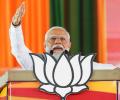
The BJP-led National Democratic Alliance's (NDA) slim majority in Lok Sabha may delay more far-reaching economic and fiscal reforms that could impede progress on fiscal consolidation, Moody's Ratings said on Wednesday. NDA securing a majority in the general elections will give a historic third term for Narendra Modi as Prime Minister of India. "We expect policy continuity, especially with regards to budgetary emphasis on infrastructure spending and boosting domestic manufacturing, to support robust economic growth.

Prime Minister Narendra Modi on Monday presented India's strong stance against terrorism, calling out the 'some countries' for their open support of terrorism and reaffirming that such 'double standards' are not acceptable.


If the men of 1983 gave India a reason to dream, the women of 2025 could give it something rarer -- the courage to live that dream in full daylight, under an open sky that finally belongs to them, points out Prem Panicker.

US President-elect Donald Trump has nominated Indian-American scientist Jay Bhattacharya to lead the National Institutes of Health (NIH), the country's top health research and funding institutions. Bhattacharya, a professor of Health Policy at Stanford University, is known for his research on the health and well-being of vulnerable populations. Trump also nominated Jim O'Neill as the deputy secretary of Health and Human Services to work alongside Robert F. Kennedy Jr.

Brave statements such as we will continue to be the fastest growing large country are of no consolation, because the direction of trade also determines the flow of investment, points out M Govinda Rao.
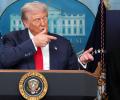
In trade negotiations, as in chess, sometimes you need to accept a temporary disadvantage to secure a better long-term position, points out Sonal Varma, chief economist (India and Asia ex-Japan) at Nomura.
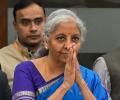
The GST Council on Wednesday approved a two-tier rate structure of 5 and 18 per cent, which will be implemented from September 22.
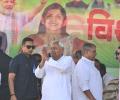
While it is evident that the INDIA bloc has not shut its doors on Nitish Kumar, those within the NDA are hopeful that the JD-U's support base would benefit them as well

'When Prime Minister Modi met President Trump, they agreed to initiate a bilateral trade dialogue.' 'It makes sense to give these negotiations a chance.'
Leading economic think-tank NCAER has advocated slew of policy reforms, including a felxible labour regime, to boost exports from the country.

Investor sentiment across Asian markets has shifted sharply in August, reveals the latest Bank of America (BofA) Fund Manager Survey, which found global growth expectations retreating after three months of improvement.
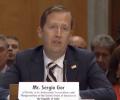
Gor underlined that President Trump has a "deep friendship" with Prime Minister Narendra Modi, and that is something that is unique.
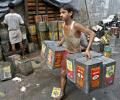
No successive government thought of reviving the idea of an exit policy.

'Both initiatives are welcome moves and we would commit ourselves with focused attention aligned with the national priorities, and pursue our exploration initiatives.'
BJP's success in two state elections gave Modi room to cut through a thicket of regulations and state controls.
Facing criticism from the government over the central bank prioritising inflation over growth, the new RBI Governor Sanjay Malhotra on Monday said that prospects of the Indian economy are expected to improve on the back of high consumer and business confidence in 2025. "As we strive to preserve financial stability to support a higher growth path for the Indian economy, our focus remains steadfast on maintaining stability of financial institutions and, more broadly, systemic stability," Malhotra said in foreword to the Financial Stability Report.
